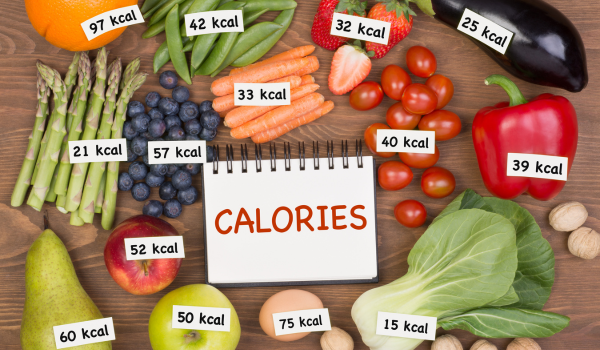
A calorie deficit happens when your body uses more energy than the calories you take in.
You can reach this imbalance by eating a little less, moving your body more, or combining both strategies.
Even though many people use calorie deficits to lose weight, the way your body responds is not always simple math.
Eating Fewer Calories
Resting metabolic needs
Your body burns a certain number of calories even when completely at rest, known as your resting metabolic rate.
Estimating needs
Researchers often use the Mifflin–St Jeor equation to estimate maintenance calories, and online calculators can do the math for you based on your age, height, weight, sex, and activity level.
Example calculation
A 40-year-old person assigned female at birth, 5’4”, 150 pounds, with a sedentary lifestyle might need around 1,700 calories daily to maintain their current weight.
Eating slightly below that amount creates a deficit.
Burning More Calories
Activity-based deficit
Instead of eating less, you can create a deficit by increasing daily movement.
Simple changes
Adding something like a brisk walk that burns 300 calories allows a person to maintain 1,700 calories of food intake and still create a deficit.
Creating A Sustainable Calorie Deficit
Avoid large drops
Cutting calories too drastically, such as going from 1,700 to 1,000 per day, may strain your body.
Potential side effects
-
Low energy
-
Slowed digestion
-
Nutrient gaps
-
Increased stress on muscles and recovery
Your body needs fuel not just to move, but also to think, heal, and maintain circulation.
Aiming For A Healthy Weight Range
Targeting long-term wellness
Instead of slashing calories hard, aim for the calorie level required to support a healthy or goal weight.
Practical example
If someone weighs 150 pounds and wants to maintain 130 pounds, using 130 pounds in a calorie calculator helps avoid going below a nourishing intake.
Whole-body approach
Pair this strategy with nourishing food choices, sleep, stress management, and physical activity for steadier progress.
Why Calorie Math Isn’t Exact
Old rule vs reality
Many people were taught that 3,500 calories equals one pound of body fat, implying that a daily deficit of 500 calories leads to a pound lost per week.
In reality, bodies adapt. Metabolism changes, hormones shift, and weight loss rarely follows a perfect linear path.
What Else Affects Weight Changes
Key influences
-
Hormones
-
Genetics
-
Medications
-
Stress and sleep
-
Gut microbiome
-
Health conditions
-
Timing of meals
-
Nutrient balance
-
Food quality, not just quantity
Quality matters
500 calories of sugary pastries affect hunger, hormones, and energy far differently than 500 calories of oats, fruit, and nuts.
Slow Progress Is More Sustainable
People who lose weight slowly—around 1–2 pounds per week—tend to maintain it better.
Even small changes, like modest improvements in blood pressure or blood sugar, offer meaningful benefits.
Progress may slow as someone approaches a goal weight, but steady habits support long-term health more than rapid restriction.


.png)



















.png)
.png)
.png)
.png)


.png)
.png)
.png)
.png)
.png)
.png)
.png)
.png)
.png)
.png)




.png)
.png)
.png)
.png)