Losing some muscle and strength is a normal part of aging, but becoming weak or inactive isn't inevitable. Even after age 60, regular resistance exercise can help maintain—and in many cases improve—leg strength, balance, mobility, and the ability to perform everyday activities independently.
You don't need a gym or complicated equipment to get started. Many effective lower-body exercises use your own body weight and can be performed at home.
The key is to begin at an appropriate level, learn proper technique, and gradually increase the challenge as you become stronger.
1. Single-Leg Balance With Reach
Balance becomes increasingly important with age because falls can lead to serious injuries and loss of independence.
A single-leg balance with reach combines balance training with lower-body strengthening. Your standing leg, foot, hips, and core must work together to keep your body stable while the opposite leg moves.
It also trains your ability to control your body when reaching or stepping in different directions—something you regularly do during everyday activities.
How To Do It
- Stand with your feet approximately hip-width apart.
- Keep a sturdy chair or countertop nearby if you need support.
- Shift your weight onto your left foot.
- Lift your right foot slightly off the floor.
- Bend your left knee slightly and reach your right foot forward.
- Lightly tap your toes against the floor.
- Return your right foot toward the starting position without placing your full weight on it.
- Reach the right foot out to the side and lightly tap the floor.
- Return to the center.
- Repeat several times before switching legs.
Move slowly and focus on maintaining control rather than reaching as far as possible.
Make It Easier
If balancing on one leg is difficult, lightly hold a chair, wall, or countertop.
You can also place your reaching foot on the floor between repetitions.
Make It Harder
As your balance improves, try:
- Reaching farther
- Performing more repetitions
- Using less hand support
- Pausing briefly while balancing on one leg
Don't progress to a harder variation until you can safely control the easier version.
2. Step-Ups
Step-ups strengthen several of the major muscles in your legs, including the quadriceps, hamstrings, glutes, and calves.
They're particularly useful after 60 because the movement closely resembles climbing stairs—an everyday task that's important for maintaining independence.
Step-ups also challenge balance and coordination because you're temporarily supporting much of your body weight with one leg.
How To Do It
- Stand in front of the bottom stair of a staircase or another sturdy, low platform.
- Place your left foot completely on the step.
- Press through your left foot and straighten your leg.
- Bring your right foot onto the step.
- Slowly step down with your right foot.
- Follow with your left foot.
- Repeat, then switch which leg leads.
Keep your chest lifted and avoid rounding your back.
Your knee should generally track in the same direction as your toes rather than collapsing inward.
Start With A Low Step
There's no benefit to immediately using a high platform.
A lower step allows you to practice the movement while reducing the strength and balance demands.
A staircase with a railing can be particularly convenient because you'll have something nearby for support.
Make It Harder
Once bodyweight step-ups become comfortable, consider:
- Increasing the number of repetitions
- Using a slightly higher step
- Holding light dumbbells
- Slowing the lowering portion
Increase the difficulty gradually.
3. Side Lunges
Most everyday movement happens forward and backward. You walk forward, sit down, stand up, and climb stairs.
But your body also needs to remain strong when moving sideways.
Side lunges train lateral movement while strengthening your glutes, quadriceps, hamstrings, hips, and inner thighs.
They're especially useful for targeting the gluteus medius, a muscle on the side of your hip that plays an important role in pelvic stability and balance.
How To Do It
- Stand upright with your feet approximately hip-width apart.
- Take a comfortable step to your right.
- Keep your chest lifted.
- Push your hips backward.
- Bend your right knee while keeping your left leg relatively straight.
- Lower only as far as you can comfortably control.
- Press through your right foot to return to standing.
- Repeat several times.
- Switch sides.
Don't worry about performing an extremely deep lunge. Range of motion can improve gradually as your strength and mobility increase.
Make It Easier
Take a smaller step and perform a shallower lunge.
You can also place a sturdy chair in front of you and lightly hold it for balance.
Make It Harder
Once you've mastered the bodyweight version, you can hold light dumbbells while performing the exercise.
Avoid adding weight until you can consistently maintain good form.
4. Squats
Squats are one of the most useful exercises for maintaining lower-body strength because they resemble movements you perform every day.
Every time you sit in a chair and stand back up, you're performing a variation of a squat.
Squats strengthen multiple muscle groups simultaneously, including your:
- Quadriceps
- Glutes
- Hamstrings
- Calves
- Hips
- Core
Because so many muscles work together, squats can be particularly valuable for maintaining functional strength.
How To Do It
- Stand with your feet approximately hip- to shoulder-width apart.
- Point your toes forward or slightly outward.
- Keep your chest lifted.
- Push your hips backward as though you're about to sit in a chair.
- Bend your knees and gradually lower yourself.
- Go only as low as you can comfortably control.
- Press through your feet.
- Squeeze your glutes as you return to standing.
Your knees should generally move in the same direction as your toes.
Use A Chair If Needed
Chair squats are an excellent option for beginners.
Place a sturdy chair behind you and slowly lower yourself until your hips lightly touch the seat. Then press through your feet to stand back up.
If necessary, sit completely before standing again.
As you become stronger, try touching the chair without fully sitting down.
Make It Harder
Progression options include:
- Performing additional repetitions
- Slowing the lowering phase
- Holding dumbbells
- Using a slightly lower chair
You don't need heavy weights to make squats challenging.
5. Kickstand Deadlift
The kickstand deadlift strengthens the muscles along the back of your body, particularly your hamstrings and glutes.
It also trains the hip-hinge movement—the movement you use when bending forward to pick something up.
Unlike a traditional two-legged deadlift, the kickstand version places most of the work on one leg. Your other foot remains on the floor for additional balance.
This allows you to train each side individually without requiring the balance needed for a full single-leg deadlift.
How To Do It
- Stand with your feet approximately shoulder-width apart.
- Shift most of your body weight onto your left foot.
- Move your right foot slightly backward.
- Lightly place your right toes on the floor as a "kickstand."
- Keep a slight bend in your left knee.
- Push your hips backward.
- Allow your torso to lean forward while keeping your spine neutral.
- Continue until you feel tension or a comfortable stretch in the back of your left thigh.
- Press through your left foot and drive your hips forward.
- Return to standing.
- Repeat before switching sides.
Think about moving from your hips rather than bending primarily through your lower back.
Make It Harder
Once you've mastered the movement, you can hold:
- One dumbbell
- Two dumbbells
- A kettlebell
- Another appropriately weighted household object
Increase resistance gradually while maintaining good technique.
How Many Sets and Repetitions Should You Do?
There's no single workout prescription that's appropriate for everyone over 60.
If you're new to resistance training, a reasonable starting point may be one set of approximately 8-12 controlled repetitions for each strengthening exercise.
As your fitness improves, you may gradually work toward two or three sets.
For balance exercises, quality is more important than completing a specific number of repetitions.
You might begin with a simple routine two days per week, allowing recovery time between sessions.
Your exercise program should become gradually more challenging as you get stronger. If the same workout remains extremely easy for months, your muscles have less reason to continue adapting.
Progress might involve:
- Adding repetitions
- Adding another set
- Increasing resistance
- Improving range of motion
- Performing movements more slowly
- Progressing to a more challenging exercise variation
You don't need to change everything simultaneously.
Why Leg Strength Becomes Especially Important After 60
Age-related muscle loss, known as sarcopenia, can gradually reduce muscle mass, strength, and physical performance.
The process can begin decades earlier but becomes increasingly important as you get older.
Your lower body contains some of your largest muscle groups, including the quadriceps, hamstrings, and glutes. Maintaining these muscles can have benefits that extend far beyond appearance.
Strong legs support your ability to:
- Walk comfortably
- Climb stairs
- Get out of chairs
- Carry groceries
- Bend down and stand back up
- Maintain balance
- Recover from a stumble
- Continue recreational activities
These abilities are closely connected with maintaining independence as you age.
Stronger Legs May Help Reduce Fall Risk
Falls become a greater concern with age, but strength and balance training can address some modifiable risk factors.
Strong legs can help you control your body while walking, changing direction, stepping over obstacles, and recovering when you lose your balance.
This is one reason exercises such as step-ups and single-leg balance drills can be valuable: they combine strength with movements that resemble real-world situations.
However, exercise can't eliminate every cause of falls. Vision problems, medications, neurological conditions, environmental hazards, and other factors can also contribute.
Create a Safer Exercise Space
Before exercising at home, take a minute to inspect your surroundings.
Remove potential tripping hazards such as:
- Loose rugs
- Electrical cords
- Shoes
- Bags
- Small furniture
- Exercise equipment lying on the floor
Make sure you have enough room to move in every direction required by the exercise.
For balance exercises, position yourself near a wall, countertop, railing, or sturdy chair.
Having support nearby doesn't make the exercise less effective. It allows you to challenge your balance more safely.
Don't Push Through Significant Pain
Exercise can cause muscle fatigue and mild soreness, particularly when you're beginning a new routine.
Sharp, sudden, or progressively worsening pain is different.
Stop the exercise if you experience significant pain, especially if it's accompanied by swelling, instability, or difficulty bearing weight.
You may need to modify the exercise or have the problem evaluated before continuing.
Choose Appropriate Footwear
Stable footing is particularly important when performing squats, lunges, step-ups, and balance exercises.
Very soft or unstable footwear can make balancing more difficult during resistance training.
Choose shoes that fit properly and provide a stable base.
Some people prefer exercising barefoot at home, but this isn't appropriate for everyone. Foot problems, balance difficulties, diabetes-related foot complications, or other medical conditions may require specific footwear recommendations.
Start With Body Weight Before Adding Resistance
Weights can make these exercises more effective as you become stronger, but they're not necessary when you're learning.
First make sure you can perform each movement with control.
Once an exercise becomes relatively easy, adding resistance can provide the additional challenge your muscles need to continue adapting.
The progression doesn't have to be dramatic.
Small increases performed consistently can add up to substantial improvements over time.
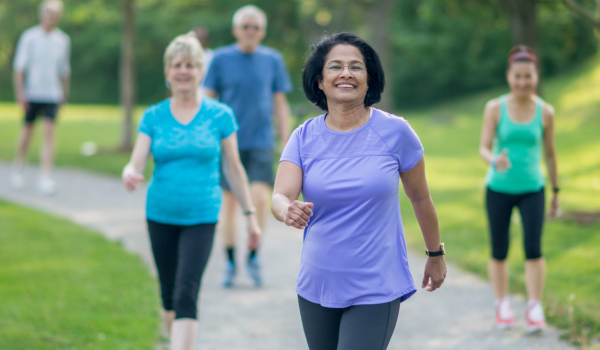
Combine Strength Training With Walking and Balance Work
Strength training is important after 60, but it shouldn't necessarily be your only form of exercise.
A well-rounded routine can include:
- Strength training
- Walking or other aerobic exercise
- Balance exercises
- Mobility and flexibility work
Each serves a different purpose.
Walking improves cardiovascular fitness and endurance, while resistance training helps maintain muscle and strength. Balance exercises train stability, and mobility exercises help maintain comfortable movement through your joints.
Together, these activities can support long-term physical function.
When To Talk With a Healthcare Professional
Consider getting individualized guidance before beginning a new exercise program if you have significant health or mobility concerns, particularly if you have:
- Recently had surgery
- Significant arthritis
- Frequent falls
- Severe balance problems
- Persistent hip, knee, or back pain
- Significant osteoporosis
- A recent fracture
- A cardiovascular condition that limits exercise
A physical therapist or other qualified healthcare professional can modify exercises according to your abilities.
You should also seek medical attention for new severe pain, sudden weakness, significant swelling, or an inability to bear weight.
The Bottom Line
You can build stronger legs after 60 without a gym or complicated equipment.
Single-leg balance reaches, step-ups, side lunges, squats, and kickstand deadlifts target many of the major muscles responsible for walking, balance, stair climbing, standing, and other everyday movements.
Start with bodyweight versions and use a chair or wall for support when necessary. Once your technique and confidence improve, gradually increase repetitions or resistance.
The most effective program isn't necessarily the hardest one. It's one you can perform safely, progressively, and consistently enough to maintain your strength, mobility, and independence for years to come.

.png)

.png)

.png)
.png)

.png)
.png)